Showing posts with label Queen Victoria. Show all posts

Monday, February 10, 2014

Weather and Other Curiosities

This is a recycled, and late (sorry), post from a group blog that is now defunct. But recycling is good for the planet, and it's too damn cold to think of anything but how I wish I was somewhere where my car didn't get stuck in the driveway, where I could venture outside without Arctic outerwear, and where my heating bill didn't creep into four figures.

******

As a native Clevelander, weather is often on my mind; when I haven't considered the weather before venturing out, I usually regret it.  Sometimes it's gorgeous, other times not so much, but it is ever-changing. Anyway, it got me thinking about where one might find information on such things in history:  weather, what the headline in the newspaper was, what was playing at Drury Lane, what people did for fun. So, this hodge-podge post offers a few, hopefully interesting, tidbits on random stuff I have been thinking about.

Weather

Frost Fair on the Thames, 1841

For some of you, this may be old news, but bear with me, as I am often the last to know anything.  Did you know that there was a “Little Ice Age” in Britain that lasted over 400 years, and didn’t end until the 19th century?  The Thames froze so thick that it was common to have Frost Fairs on the river during the winter months.   Google “Frost Fairs” and you will find a number of pictures and articles.  The last frost fair was held in 1841; this picture of that event is courtesy of the Daily Mail.

You can find data on average temperature (1659 forward) and precipitation (1766 forward) in England on the website of the Royal Meterological Society.  

This site has interesting descriptions of English winters from the 17th century to the present day.  For example, 1816 was the year without a summer, and on Christmas day in 1836, snow accumulated up to 15 feet, with drifts of up to 50 feet!

That last site refers to a volcanic eruption having an impact on English weather, not unlike the eruption that we all remember from 2010.  Thinking about this made me wonder about historical weather events outside of England that may have had an impact, such as this 18th century volcanic eruption in Iceland.  

Newspapers

The first issue of The Times, 1788

Although news was not instantaneous in the 18th and 19th centuries, as it is today, newspapers nevertheless played an important role in daily life, and can offer a wealth of information, including, of course, what was playing at Drury Lane (on December 4, 1788, it was Mr. Kemble in Rule a Wife, and Have a Wife).
The British Library offers online access to British newspapers from 1800 to the present day.   An article on the British Library website reports the following: "In 1800, four main daily newspapers were being published in London, of roughly equal importance: the Morning Post; the Morning Chronicle; the Morning Herald and The Times."  

Access to the British Library collection is by subscription, although it is free if you are affiliated with a subscribing institution, such as a British university.  Another interesting summary of British newspapers is available at http://www.georgianindex.net/publications/newspapers/news_sources.html.  There are some newspapers available at the National Archives, and you can also find a number of periodicals on GoogleBooks--for reasons which escape me, there is particularly good coverage of the Journal of the Royal Agricultural Society, with marvelously titled articles like "Wild Birds, Useful and Injurious (With Seven Illustrations)" and "Marigolds Running to Seed."

This site offers access to a few 18th century journals for free: http://www.bodley.ox.ac.uk/ilej/; and this one offers links to a number of other sites, including German, French, Dutch and other European papers: http://www.xooxleanswers.com/free-newspaper-archives/newspaper-archives-europe/.   You can find information on Canadian newspapers at http://www.thecanadianencyclopedia.com/articles/newspapers.  

Entertainments

--Theatre
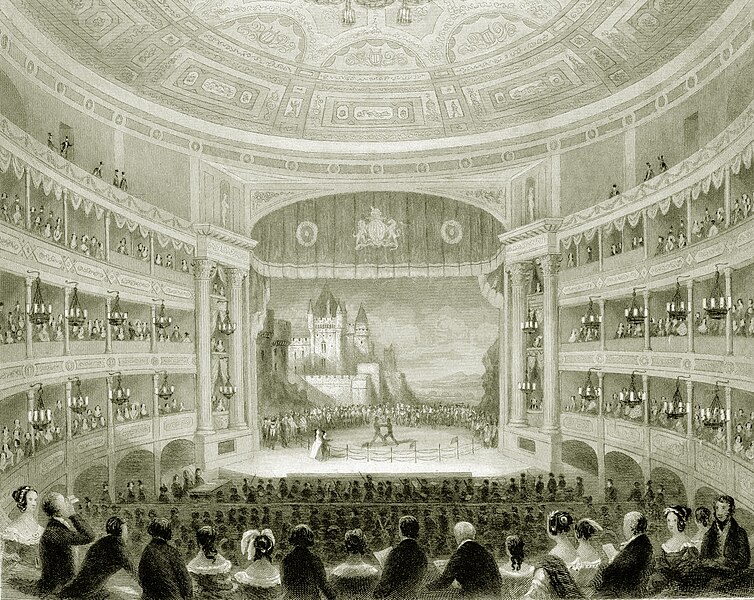
Theatre Royal, Drury Lane, 1842

Much is made of theatre in period literature and in historical fiction.  It was an amusing diversion both for the rich and those less well-off, and for the former, it was a place to see and be seen.

This is an interesting article on the business of nineteenth century theatre and its personalities: http://www.vam.ac.uk/content/articles/0-9/19th-century-theatre/.  This article offers facts on the individual theatres: http://www.victorianweb.org/mt/theaters/pva234.html.  Some tidbits: The Adelphi was the first theatre to feature adaptations of the novels of Charles Dickens; the first female theatre manager in London was Eliza Vestris, who managed the Olympic Theatre in 1830; the celebrated actor Edmund Kean made his Drury Lane debut in 1814 as Shylock in The Merchant of Venice.

--Vauxhall
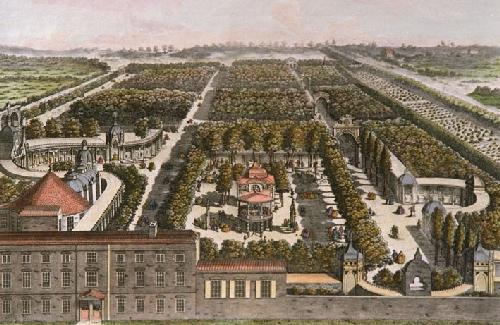
Vauxhall Gardens by Samuel Wale, c1751
What post on historical English curiosities could be without a note on Vauxhall Gardens? They were the celebrated "pleasure gardens" which feature rather heavily in historical romance novels, with heavily wooded paths and secluded arbors just perfect for trysting aristocrats.  Vauxhall closed in 1859--for reasons which will surprise no one, it wasn't as popular after Victoria took the throne--but during the decadent Regency period it was simply the place to be. There is a marvelous description of Vauxhall from 1760 by Goldsmith, in Curiosities of London: Exhibiting the Most Rare and Remarkable Objects of Interest in the Metropolis; With Nearly Fifty Years' Personal Reflections, by John Timbs (p. 747, available on GoogleBooks):

"The illuminations began before we arrived; and I must confess that upon entering the Gardens I found every sense overpaid with more than expected pleasure: the lights every where glimmering through scarcely moving trees; the full-bodied concert bursting on the stillness of night; the natural concert of the birds in the more retired part of the grove, vieing with that which was formed by art; the company gaily dressed, looking satisfied, and the tables spread with various delicacies,--all conspired to fill my imagination with the visionary happiness of the Arabian lawgiver, and lifted me into an ecstasy of admiration."  

As I can't possibly top that, I bid you adieu until next time,

Marin

Sunday, January 12, 2014

Technology in the Victorian Era

So a couple of months ago I sat in on my son's 5th grade Science class. They were watching a documentary on the Apollo space program, called In the Shadow of the Moon. It occurred to me as I watched that I was the only one in the room who was alive during the first moon landing--even the teacher wasn't born until after the Apollo program had ended. Whether it's a wholly accurate memory or not, I remember sitting in the dining room while my mother cooked, watching the moon landing on our tiny black and white TV.

One of the astronauts in the program said that his father was born around the time of the Wright Brothers' first flight, and the astronaut's son was four when the astronaut went to the moon. The astronaut's father could not even imagine a time when a man could fly to the moon, yet to the son, it was inconceivable that it would not be possible to fly to the moon.

When I mentioned these musings on Facebook, it led to a rousing comment thread, discussing all the technological innovations that have happened in our own lifetimes, or those of our parents. Naturally, since I am immersed in editing my Victorian era WIP, I thought back to that period.

The Victorian era was one of the most sustained and prolific periods for technological and scientific advancement in history. These advancements created significant chances in society, giving rise to the middle class and a new type of wealth.

It saw the rise of the railroad and the improvement of the steamship. The first steam-assisted crossing of the Atlantic took place in 1819, before Victoria, and took 633 hours (just over 26 days). By 1901, the year of Victoria's death, it took only 5 days to cross. Likewise, the railway era started before Victoria's reign, in 1825, but by 1900, trains ran regularly, and with complete safety, at speeds in excess of 70 miles per hour. The first lavatories appeared on trains in the 1860s, the first sleeping cars were introduced in 1873, and dining cars came into use from 1879. (Source: http://www.bbc.co.uk/history/british/victorians/victorian_technology_01.shtml#three).

The Victorian era also saw these inventions that we take for granted today:

Photograph (1838)
Pedal bicycle (1839)
Postage stamp (1840)
Christmas card (1843
Rubber tires (1845)
Tarmac (1845) and concrete (1849)
Sewing machine (1846)
Gasoline/petrol (1850) and oil (1859)
Flushing toilet (1852)
Steel (1854)
Safety match (1855)
The first underground railway opened in London (1863)
Typewriter (1873)
Chocolate Easter eggs (hurray!) (1875)
Telephone (1876)
First recording of human voice (1877)
Electric street lamps (1878)
Electric light bulb, for home use (1879) (the first electric light bulb was patented in 1875)
Gramophone (1887)
The Kodak box camera (1888)
Comic book (1890)

Cinematograph (1894)
X-ray (1895)
Radio (1895)

(Source: http://resources.woodlands-junior.kent.sch.uk/homework/victorians/inventiotimeline.html)

The Victorian period saw the serialization of novels in magazines, which made them more accessible to the public. This is unrelated to technology, but just to give you an idea of the breadth of the Victorian literary world, some lists:

Victorian novelists, in no particular order, included Nathaniel Hawthorne (1804-1864), William Thackeray (1811–1863), Emily Bronte (1818-1848), Charlotte Bronte (1816-1855),  Anne Bronte (1820-1849), George Eliot (1819-1880), Anthony Trollope (1815-1882), Elizabeth Gaskell (1810–1865), Charles Dickens (1812-1870), Louisa May Alcott (1832-1888), Thomas Hardy (1840-1928), Rudyard Kipling (1865-1936), Mark Twain (1835-1910), Henry James (1843-1916), Robert Louis Stevenson (1850-1894), and so many others I'd be here all day if I listed them all.  The era also produced poets Alfred, Lord Tennyson (1809-1892), Robert Browning (1812-1889), Elizabeth Barrett Browning (1806-1861), Dante Gabriel Rossetti (1828-1882), A.E. Housman (1859-1936), and Emily Dickinson (1830-1886). Playwrights included George Bernard Shaw (1856–1950) and Oscar Wilde (1854–1900). There is a more comprehensive list and some other great stuff at A Literary Odyssey.

Anyway, all of this change is why I set my writing in the period. The dramatic possibilities are endless.

Now I think I'll go pull one of my Elizabeth Gaskell novels off the shelf, and settle in with a cup of tea.

About Me

My photo
Clevelanders are tough, a bit cynical, and just a little crazy, and Marin McGinnis is no exception. She writes tales of Victorian-era romance. When she's not chasing after big dogs or watching small children skate around Ohio hockey rinks, you can find her hanging out here, on her group blog at http://throughheartshapedglasses.com/, on Facebook at http://www.facebook.com/MarinMcG, or on Twitter @MarinMcGinnis.

Search This Blog