Sunday, September 14, 2014

Another visit to Akron

Akron's been on my mind lately, as I've been there more in the past two weeks than I have in years. Okay, only twice, but still.

Last week my husband and I went to a concert (Wilco, in case you were wondering) at the Akron Civic Theater, which is truly one of the oddest looking buildings I think I've ever been in.

Strangely enough, given that my dad grew up in Akron and my grandmother lived there almost her entire adult life, I had never been there before.  It was originally envisioned as "the Hippodrome," a 3,000 seat movie theater with an arcade full of shops and restaurants. It was designed in 1919 by L. Oscar Beck, an Akron dance hall owner. Construction began and the lobby was built, but the project was bankrupt by 1921. In 1925, the abandoned lobby and adjacent land along the Ohio and Erie Canals were purchased by Marcus Loew--who founded the Loew's theater chain and Metro-Goldwyn-Mayer studios--and designed by architect John Eberson.

The theater was completed in 1929, two years after Loew's death. Its interior was fashioned after a Moorish castle featuring Mediterranean decor, including medieval carvings, European antiques and Italian alabaster sculptures. Eberson also designed the theater to be "atmospheric," featuring twinkling starlit skies (seriously, it's wild--this picture of mine doesn't do it justice at all) and drifting clouds.

Proscenium arch, Akron Civic Theater

I had never seen or heard of an atmospheric theater before, so being the nerd that I am I needed to do some digging. The Akron Civic is one of the largest remaining examples of atmospheric theaters in the US. It was nearly destroyed in the 1960s, but for the enterprising persistence of a group of Akron matrons, who saved the theater from destruction and insured its continued success. (Ironically, they did so in part by selling popcorn, the smoke and grease from which so blackened the walls that the theater underwent a $19 million cleaning and renovation in 2001. Or at least that's what the guy selling beer(and no popcorn) told us.)

John Eberson was born in Romania in 1875 and immigrated to the U.S. in 1901. He developed the atmospheric design, and by the end of his career had designed anywhere from 100 to 1,200 theaters, depending on which website you choose, all over the world. Usually designed with European themes, Eberson’s theaters featured large sky-blue ceilings with twinkling stars and clouds, and facades on either side. You can almost imagine you are in a courtyard in some ancient European city. Almost. We really weren't sure what the fake Christmas trees along the top were doing in a Moorish castle.

Left facade, Akron Civic Theater
.
It's curious that so many of his theaters are in Ohio, and some in relatively small towns as well. Eberson designed the Colony Theater in Shaker Heights, which is now Shaker Square Cinemas (a slightly bizarre art deco space), as well as theaters in Marion, Canton, Bellefontaine (the only one with a Dutch motif and working windmills), Bryan, Celina, Norwalk. Perhaps it is because he built his first theater, the Jewel, in Hamilton, Ohio, and started his own architectural firm in Hamilton.

Have you ever been in an "atmospheric" theater? What did you think?

Resources 
In addition to the links embedded above, check out these sites for more information and some great pictures:
http://www.ohio.com/lifestyle/akron-s-lost-landmark-retains-a-grand-facade-1.154282
http://en.wikipedia.org/wiki/John_Eberson
http://auburncinefile.com/schines_friends_page
There are some wonderful examples of Eberson's work at this interesting blog about, of all things, ornamental plaster.


Sunday, August 31, 2014

We're going to the zoo, zoo, zoo...

I love zoos. I am glad that I still have a relatively small kid so I can go to the zoo without making excuses, but I would go even if I didn't. We are blessed in Northeast Ohio to have not one but two great zoos: the Cleveland Metroparks Zoo and the Akron Zoo. My son and I visited the Akron Zoo last weekend, and it inspired me to think about the history of zoos.

The predecessor to the modern zoo was known as a menagerie, and the oldest of those is believed to have been in Egypt, circa 3500 BC.  Zoos were kept by the ancient Greeks and the Romans, although it seems that the latter kept them primarily to house the animals which fought in the Colosseum.

Source: "The Tower Menagerie."
The first British zoo was a collection of exotic animals amassed by Henry I in the 12th century, housed at the royal residence in Woodstock. The Royal Menagerie was started by King John in the early 13th century, and was housed in the Tower of London until 1835. The "Lion Tower" was built by Henry III to house a trio of leopards given to the king by Emperor Frederic II; another building was erected in 1255 to house an elephant gifted by Louis IX.

The collection was not opened to the public until the 16th century, when the Tower housed a lion and several lionesses, a tiger, a lynx, a wolf, a porcupine and an eagle. Conditions were such as would appall us now--habitats more resembled prisons than the natural settings we use today, and the food offered was unconventional--King James I's elephant, for example, was given wine from April to September, as it was believed it could not drink water at that time of year.

By the early 1830s, the zealous efforts of the menagerie's dedicated keeper, Alfred Cops, had resulted in a collection of over 280 animals. Given the size, and the fact that over the years the animals had developed a habit of occasionally attacking guests (in the 18th century a baboon hurled a cannon ball at a visitor, killing him), it was determined that the Tower was no longer the appropriate place to house them, and the majority of them were donated to the London Zoo in Regent's Park.

The London Zoo in Regent's Park, 1828. Source: Wikipedia. 


The London Zoo opened in 1828 and is the world's oldest scientific zoo. Access to the zoo was originally granted only to members of the London Zoological Society, but it was opened to the public in 1847.


Photo by Derek Ramsey, via Wikimedia Commons. 


The first zoo in the United States was chartered in 1859 in Philadelphia, but did not become a reality until 1874. The zoo rests on the land once owned by John Penn, grandson of William Penn, the founder of Pennsylvania.


Sea Lions at Wade Park Zoo. Source: Cleveland State University.

The zoo I know the best, Cleveland Metroparks Zoo, was founded in 1882 in Wade Park, which now houses the Cleveland Museum of Art, the Cleveland Museum of Natural History, and the Cleveland Botanical Gardens. The Zoo moved to its current location in Brookpark, just west of Cleveland, in 1914.
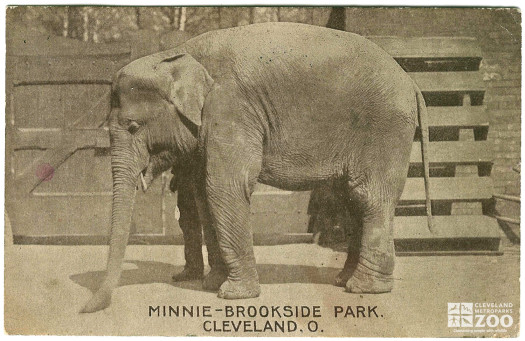
Minnie the Elephant, 1910. Source: Cleveland Metroparks Zoo.


The Zoo's first elephant, Minnie, was acquired through the "Pennies From Children" fundraising campaign in 1907.


Wade Park Barn. Source: Cleveland State University.


The Wade Park Zoo began with a donation of 14 deer, and they lived in a Victorian-style barn built just for them in 1884. It moved along with the animals to Brookpark, and now is one of my son's favorite places at the zoo--it serves as a Ben & Jerry's ice cream shop.


My favorite site at the zoo, however, is the meerkat habitat.


The Akron Zoo, to the south of Cleveland, opened in 1900 on land donated by heirs of the founder of the City of Akron, Simon Perkins. It's much smaller than Cleveland's zoo, but it's lovely, AND it has penguins.


I have visited zoos in at least nine states (so far), and could write about all of them, but right now I have the strangest urge to go to the zoo. . .

Some resources:
*The Smithsonian's collection of historical documents and images of zoos: http://www.sil.si.edu/ondisplay/zoos/intro.htm
*World's First Zoo: http://archive.archaeology.org/1001/topten/egypt.html
*Wikipedia's article on the history of zoos is pretty comprehensive: http://en.wikipedia.org/wiki/Zoo
*A story about the great cats housed in the Tower of London: http://news.bbc.co.uk/2/hi/science/nature/4371908.stm
*http://www.hrp.org.uk/TowerOfLondon/stories/buildinghistory/royal-menagerie
*This book features a history of the Tower Menagerie and descriptions of all the animals at one time housed within it, which perhaps owe rather more to drama than to accuracy. "The Tower Menagerie: Comprising the Natural History of the Animals Contained in that Establishment : with Anecdotes of Their Characters and History," by Jennings (1829). (Available on Google Books.)
*http://www.dailymail.co.uk/news/article-1313816/The-polar-bear-lived-Tower--grumpy-lion-baboon-threw-cannon-balls-Britains-bizarre-zoo.html
*Philadelphia Zoo: http://www.philadelphiazoo.org/About-the-Zoo.aspx
*Wade Park Zoo: http://clevelandhistorical.org/items/show/387#.VANkL_ldWJE
*Cleveland Metroparks Zoo: http://clevelandhistorical.org/items/show/506#.VANmRPldWJE and http://resourcelibrary.clemetzoo.com/historicals/1
*Akron Zoo: https://www.akronzoo.org/History/3/33/293


About Me

My photo
Clevelanders are tough, a bit cynical, and just a little crazy, and Marin McGinnis is no exception. She writes tales of Victorian-era romance. When she's not chasing after big dogs or watching small children skate around Ohio hockey rinks, you can find her hanging out here, on her group blog at http://throughheartshapedglasses.com/, on Facebook at http://www.facebook.com/MarinMcG, or on Twitter @MarinMcGinnis.

Search This Blog